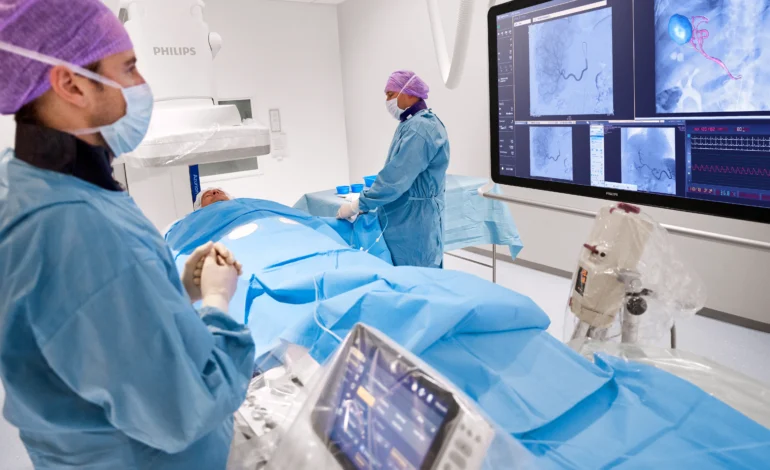
A new congress feature published by EMJ Reviews highlights how Artificial Intelligence (AI), robotics, augmented reality (AR), and virtual reality (VR) are transforming the future of Interventional Radiology (IR). Presented during the European Congress of Radiology (ECR) 2026, the session explored how these advanced technologies are improving precision, training, safety, and efficiency in minimally invasive medical procedures. The report describes IR specialists as performers who must combine timing, decision-making, and technical skill in real time—making them ideal users of intelligent technologies.
What Is Interventional Radiology?
Interventional Radiology is a medical specialty that uses imaging guidance such as:
- CT scans
- Ultrasound
- MRI
- Fluoroscopy (live X-ray)
to perform minimally invasive procedures like:
- Biopsies
- Tumor ablation
- Drainage procedures
- Stent placement
- Vascular treatments
- Targeted injections
Because these procedures require extreme precision, AI and robotics are now becoming valuable tools.
Why AI and Robotics Matter in IR
Unlike diagnostic radiology, which often focuses on reviewing images, interventional radiology requires doctors to make rapid decisions during live procedures. AI and robotics can assist by:
- Improving accuracy
- Reducing human error
- Enhancing real-time guidance
- Lowering radiation exposure
- Shortening procedure time
- Supporting complex navigation
Experts at ECR 2026 said the future of IR will blend human skill with machine intelligence.
Augmented Reality (AR): Overlaying Digital Guidance
One of the biggest themes discussed was Augmented Reality, which overlays digital visuals onto the real-world environment instead of replacing it.
In interventional radiology, AR can help doctors by showing:
- 3D anatomy projections
- Needle path guidance
- Tumor location overlays
- Radiation scatter visualization
- Live positioning assistance
This can improve confidence during delicate procedures. Early studies mentioned in the report showed strong targeting accuracy during AR-guided liver lesion ablation.
Virtual Reality (VR): Training Without Risk
Virtual Reality fully immerses users in a digital environment. In radiology, VR is being used for:
- Training new doctors
- Catheterization simulations
- Procedure rehearsal
- Stress reduction for patients
- Rehabilitation therapy
Because it creates a realistic but risk-free environment, VR may become a major part of medical education.
Robotics in Interventional Radiology
Experts clarified that today’s “robots” in IR are not fully autonomous machines. Instead, they function more like highly precise remote-controlled tools guided by physicians.
Robotic systems can assist with:
- Needle placement
- Biopsy targeting
- Tumor ablation procedures
- Catheter movement
- Fine instrument control
Benefits include:
- Greater precision
- Reduced radiation for staff
- Less physical strain
- Potential for remote procedures in future
New Robotic Systems Mentioned
The article highlighted emerging platforms such as:
LIBERTY®
A compact system designed for low-cost, single-wire interventions with simplified setup.
SENTANTE™
Allows multi-device control using a simulator-like interface for better maneuverability.
These systems aim to make robotic assistance more practical and accessible.
How AI Is Changing the IR Toolkit
Artificial Intelligence can help before, during, and after procedures.
Before Procedure:
- Analyze scans
- Plan safest route
- Predict complexity
- Select ideal tools
During Procedure:
- Real-time tracking
- Tissue movement correction
- Needle guidance
- Risk alerts
After Procedure:
- Measure success margins
- Detect complications
- Compare outcomes
- Improve future planning
Challenges Still Remaining
Despite strong promise, experts also noted barriers:
- High equipment cost
- Workflow integration difficulty
- Need for physician training
- Limited automation in vascular procedures
- Accuracy on moving anatomy
- Regulation and safety standards
Widespread adoption will likely take time.
Why This Matters for Patients
If implemented successfully, these technologies may lead to:
- Smaller incisions
- Faster recovery
- More precise treatment
- Lower complication risk
- Less radiation exposure
- Better access through tele-intervention in remote areas
This could significantly improve patient outcomes in many specialties.
Bigger Trend: Human + Machine Collaboration
The report made clear that AI and robotics are not replacing radiologists. Instead, they are designed to enhance the doctor’s performance, much like advanced instruments help a musician on stage.
The future model is expected to be:
Doctor leads + Technology assists
rather than autonomous medicine.
The EMJ Reviews feature shows that interventional radiology is entering a new era where AI, AR, VR, and robotics could transform how procedures are performed. From smarter planning to robotic precision and immersive training, these tools may make treatment safer, faster, and more effective. While challenges remain, the operating suite of the future is clearly becoming more intelligent.