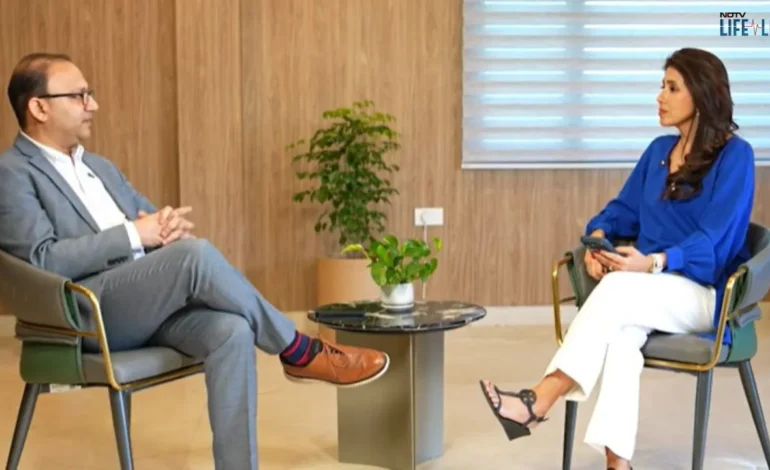
Kotak Mahindra Bank’s chief executive officer and managing director, Ashok Vaswani, opted not to seek re-election by the end of the year, leading to a potential search for a successor. The 35-year veteran’s tenure in the bank has been defined by significant events, and its profits have seen a decline over the past quarters.
Within three months of Vaswani taking charge as the top chief, the country’s fourth-largest private lender faced one of its biggest challenges. In April 2024, the bank was barred from onboarding new customers on its digital platform and issuing fresh credit cards by the Reserve Bank of India, due to supervisory concerns over its tech platforms. The ban was then lifted 10 months later.
Then came the war in West Asia, which has been ongoing since late February this year. Although Vaswani said that the bank will closely monitor the fallout of the war, the bank did not make any provisions for the same, while warning that margins will shrink throughout FY27.
Kotak Mahindra Bank has still been able to deliver operationally, with its balance sheet expansion, even as it has seen its net profits decline from its June 2025 quarter high.
Balance sheet growth
During Vaswani’s tenure as the CEO, the bank’s balance sheet witnessed significant growth. At the end of FY24, the bank’s asset franchise was at Rs 3.76 lakh crore, which increased to Rs 4.26 lakh crore as at the end of the fiscal year FY25. While it was during April when the bank faced the RBI ban on credit card issuances, there was no material hit to the asset book.
The bank ended FY26 with a loan book of Rs 4.96 lakh crore, a near 70,000 crore jump from the previous fiscal. From FY24 to FY26, the bank’s advances grew around 30 percent. The acquisition of Standard Chartered India’s Rs 3,330 crore personal loan book in 2025 proved to be beneficial too.
The bank’s liabilities’ profile also expanded in tandem, although at a slightly slower rate. At the end of FY24, Kotak had deposits worth Rs 4.48 lakh, which grew to Rs 5.72 lakh in the fiscal year, a 27 percent growth.
Profits fluctuations
Despite a regulatory overhang and a potential fallout from a war, Kotak Mahindra Bank continued to report earnings growth during Vaswani’s tenure. As of the end of the March 2024 quarter, the company’s standalone net profit came in at Rs 4,133 crore, with a net interest income (NII) of Rs 6,909 crore.
The company is still able to command a price-to-earnings (P/E) valuation higher than some of its peers, such as Axis Bank, ICICI Bank, and HDFC Bank. The stock is currently trading at a P/E of 21.4X, while the others are trading at a multiple between 16.1X and 18.3X.
Kotak continued to report profits throughout the two years of Vaswani’s tenure, although the rate of profit growth declined in the subsequent quarters. From the June quarter of FY25, the company reported a net profit of Rs 6,249 crore, which has since taken a significant hit.
At the end of FY25, the company’s net profit had nearly halved to Rs 3,551 crore, even though the NII rose to Rs 7,283 crore at the end of the March 2025 quarter. This profit fall is attributed to the large provisions for bad loans in the microfinance (MFI) and unsecured retail segments. Moreover, the RBI-imposed technology ban had taken a hit on the bank’s profits.
At the end of FY26, the lender had partially managed to regain some of its lost sheen, with its net profit rising to Rs 4,026 crore, on an NII of Rs 7,875 crore.
Kotak’s asset quality remained robust, however, with the gross non-performing asset ratio (GNPA) ratio gradually coming down to 1.2 percent as of the end of FY26, as compared to 1.39 percent in FY24-end.
“We believe Kotak is entering the next phase of its growth journey with most of the heavy lifting now behind it. With a sharper focus….KMB appears well-poised to accelerate growth without compromising on risk discipline,” Axis Securities had written in a recent research note.
Premium valuation but share price underperformance
The company is still able to command a price-to-earnings (P/E) valuation higher than some of its peers, such as Axis Bank, ICICI Bank, and HDFC Bank. The stock is currently trading at a P/E of 21.4X, while the others are trading at a multiple between 16.1X and 18.3X.
The premium valuation, however, has not translated into superior returns. The stock gained only modestly during Vaswani’s tenure and underperformed larger private-sector peers such as ICICI Bank and Axis Bank, among others.
From January 2024 to the June-end of 2026, the stock has managed to give a return of merely 10 percent, while ICICI Bank has given a return of nearly 40 percent. It has, however, managed to outperform HDFC Bank, which has given a return of a much lower 5 percent during the same period.
Some of the mid-sized private banks, such as Federal Bank and South Indian Bank, have given double-fold returns as well during the same period.
Now, for Vaswani’s successor, the challenge will not be more about balance-sheet growth, but rather about delivering robust returns to shareholders. Moneycontrol had exclusively reported that insiders Paritosh Kashyap and Anup Saha could be seen as possible successors.
“We believe a Board recommendation by Sep-Oct’26 is plausible. The risk event is an external hire, which may raise questions around the Board’s succession process and create near-term execution uncertainty. We believe the CEO transition is unlikely to alter Kotak’s strategic direction,” Nomura said in a research note.
Also Read this : LIC Shares Surge After Strong Q4 Results as Net Profit Rises 23%