
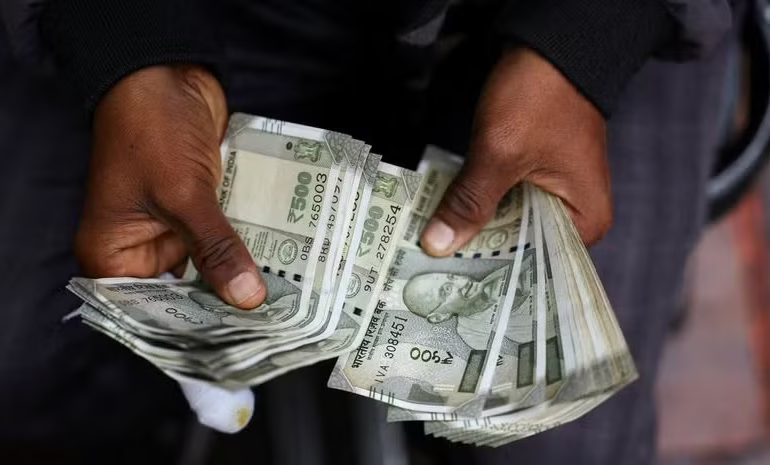
The Reserve Bank of India (RBI) is revisiting its long-discussed proposal to introduce polymer banknotes as part of efforts to improve the durability of currency notes and reduce long-term printing costs. The move comes at a time when demand for physical cash continues to grow despite the rapid expansion of digital payment systems across the country.
According to sources familiar with the matter, the proposal was discussed during the RBI’s last two board meetings held in Patna and Mumbai. The central bank is now considering a pilot project that could pave the way for the wider circulation of plastic or polymer-based currency notes in India.
RBI Considers Pilot Project for Polymer Notes
Sources indicate that the RBI is preparing to launch a pilot program involving polymer banknotes for public use. The initiative aims to evaluate the performance, durability, and public acceptance of plastic currency before a larger rollout.
Polymer notes are made from a specialized plastic substrate rather than traditional cotton-based paper. These notes are already in circulation in several countries and are known for their resistance to wear and tear.
An official familiar with the discussions stated that advances in technology have made it easier to integrate polymer notes into India’s banking infrastructure, including ATMs and cash-handling systems.
Rising Printing Costs Prompt Policy Shift
One of the key reasons behind the RBI’s renewed interest in polymer currency is the increasing cost of printing traditional paper notes.
According to the RBI’s Annual Report for FY25, the expenditure on securely printing banknotes rose significantly to ₹6,372.8 crore during 2024-25, compared to ₹5,101.4 crore in the previous financial year. The increase was primarily attributed to higher demand for banknote printing.
Officials believe polymer notes could offer long-term savings because they last considerably longer than paper notes, reducing replacement and printing expenses over time.
Longer Lifespan Could Reduce Currency Waste
The disposal of worn-out and soiled banknotes has become a major challenge for the central bank.
Data from FY25 shows that 23.8 billion soiled banknotes were withdrawn and disposed of, representing a 12.3% increase from 21.24 billion notes in the previous year. The majority of damaged notes belonged to the ₹500 denomination, followed by ₹100 notes.
Since polymer banknotes are more durable and resistant to moisture, dirt, and tearing, they could significantly reduce the volume of notes that need replacement each year.
Cash Demand Remains Strong Despite Digital Payments
Although India has emerged as a global leader in digital payments through platforms such as UPI, demand for physical currency remains robust.
Currency in Circulation (CiC) grew by 11.5% year-on-year to reach a record ₹42.86 trillion as of May 15. In the first one and a half months of FY27 alone, currency circulation increased by ₹1.15 trillion, highlighting the continued reliance on cash for daily transactions.
The steady rise in cash demand has further increased the burden on currency printing operations, making the case for more durable banknotes stronger.
Growing Need for Lower-Denomination Notes
Sources also pointed to the sustained demand for lower-denomination banknotes, particularly ₹10 and ₹20 notes, over the past several years.
Despite their frequent use, these denominations account for only a small share of the total value of banknotes in circulation. The ₹10 note represented just 0.7% of total currency value over the last two years, while the ₹20 note accounted for around 0.8%.
Because lower-denomination notes change hands more frequently, they wear out faster, making them ideal candidates for polymer-based alternatives.
Technology Challenges No Longer a Barrier
India had previously explored polymer banknotes but faced concerns related to production technology, ATM compatibility, and note authentication systems.
However, banking and currency experts now believe these challenges have largely been resolved. Modern ATM systems and currency-sorting machines can be configured to recognize and process polymer notes efficiently.
The RBI is reportedly confident that the existing banking infrastructure can support the transition if the pilot project proves successful.
Global Adoption of Polymer Currency
Polymer banknotes have gained widespread acceptance across the world due to their durability and enhanced security features.
Australia became the first country to introduce polymer currency in 1988 with its ten-dollar note. Since then, several nations including Singapore, Indonesia, Thailand, Malaysia, Canada, and Romania have adopted plastic banknotes.
Romania became the first European nation to introduce polymer currency in 1998, while Canada began circulating polymer notes in 2011. Today, more than 60 countries use polymer banknotes either fully or partially.
Meanwhile, the United States continues to use banknotes made from a specialized cotton-linen blend rather than polymer.
What the Move Could Mean for India
If implemented successfully, polymer banknotes could represent one of the most significant changes to India’s currency system in recent years. The transition may help reduce printing costs, improve the lifespan of banknotes, lower disposal volumes, and enhance security features.
With cash demand remaining resilient and currency management costs rising, the RBI’s renewed focus on polymer notes signals a strategic effort to modernize India’s currency infrastructure while ensuring greater efficiency in the years ahead.