
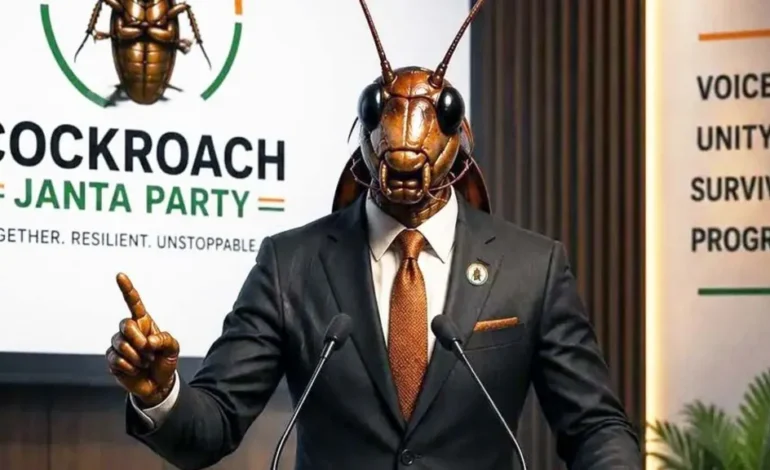
The Indian government has reportedly treated the viral “Cockroach Janta Party” (CJP) social media movement as a potential national security issue and directed X (formerly Twitter) to block the account in India authorities believe some content shared by the satirical political movement could pose risks related to public order and national security.
The move has intensified the debate around digital activism, political satire, online censorship, and freedom of expression in India. The Cockroach Janta Party has rapidly emerged as one of the most viral youth-led online movements of 2026, attracting millions of followers and widespread political attention.
What Is the Cockroach Janta Party?
The Cockroach Janta Party (CJP) is a satirical online political movement founded by Abhijeet Dipke after controversial remarks allegedly comparing unemployed youth to “cockroaches” triggered outrage online. The movement quickly transformed into a viral social media campaign focused on issues such as unemployment, inflation, political frustration, and youth dissatisfaction.
CJP describes itself as the “voice of the unemployed and frustrated youth.” Through memes, satire, digital campaigns, and political commentary, the group gained massive support among Gen Z audiences across India. Reuters reported that the movement amassed millions of followers within days and attracted hundreds of thousands of registrations.
Why Did the Government Ask X to Block the Account?
According to reports, the Ministry of Electronics and Information Technology (MeitY) directed X to withhold the account under Section 69A of the Information Technology Act after receiving inputs from intelligence agencies.
Government officials reportedly believed that certain posts published by the account were “inflammatory” and could potentially affect national security and public stability. Authorities were also concerned about the speed at which the movement was gaining popularity among young users online.
The Indian Express report stated that intelligence agencies viewed the account as a possible threat because of its rapidly expanding influence and political messaging.
What Is Section 69A of the IT Act?
Section 69A of India’s Information Technology Act gives the central government the authority to order internet platforms and intermediaries to block online content under certain circumstances. These can include:
- National security concerns
- Public order issues
- Threats to sovereignty and integrity
- Prevention of incitement or unlawful activities
The law has been used previously to block websites, social media accounts, apps, and online content deemed sensitive or harmful by authorities.
X Account Withheld in India
Following the government order, the Cockroach Janta Party’s X account was withheld in India. Users accessing the page inside the country reportedly saw a notice indicating that the account had been blocked due to legal demands.
However, reports suggest the account remained accessible outside India.
The movement’s founder, Abhijeet Dipke, publicly acknowledged the action and claimed that attempts were also made to compromise the organization’s Instagram account.
Social Media Popularity and Youth Support
The Cockroach Janta Party became especially popular among younger audiences because it used humor and satire to discuss serious social and economic issues. Topics frequently addressed by the movement include:
- Youth unemployment
- Rising inflation
- Cost of living pressures
- Political accountability
- Media freedom
- Mental health and social frustration
Reuters reported that nearly 70% of the movement’s supporters belong to the 19–25 age group, highlighting the strong connection between the campaign and India’s younger generation.
The movement reportedly crossed millions of Instagram followers and briefly surpassed several mainstream political parties in online engagement metrics.
Political Reactions and Debate Over Free Speech
The blocking of the account sparked political reactions from opposition leaders and commentators. Congress MP Shashi Tharoor publicly criticized the decision and argued that democratic societies must allow room for satire and dissent.
The incident has fueled wider discussions around:
- Freedom of expression in India
- Regulation of digital platforms
- Political satire online
- Government oversight of social media
- Youth political activism
Supporters of the movement argue that the account represented peaceful satire and criticism, while others believe governments have a responsibility to monitor content that could potentially create instability.
Digital Satire Becoming a Political Force
Political analysts believe the Cockroach Janta Party reflects a growing trend where internet-driven satire evolves into large-scale political discourse. Social media platforms are increasingly becoming spaces where younger citizens express frustration over economic conditions, governance, and representation.
Experts also note that meme-based political communication is becoming highly influential because it combines entertainment with social commentary in a format easily shared online.
The government’s decision to block the Cockroach Janta Party account on X has turned the viral satirical movement into a major national political discussion. What began as an internet joke has evolved into a broader conversation about censorship, youth frustration, political satire, and digital freedom in India.